

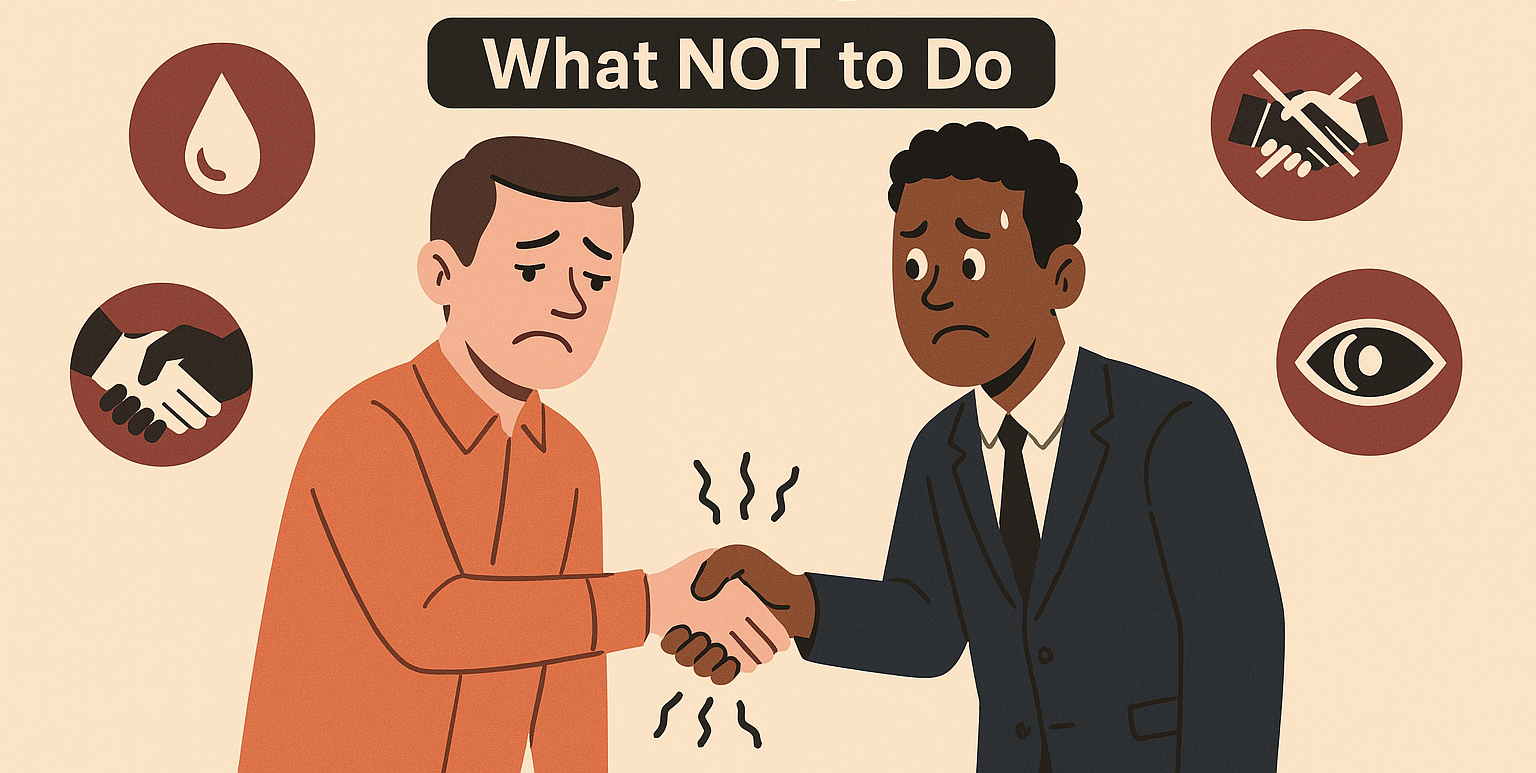
Never mess up a handshake because while people hardly remember a good handshake, they never forget a bad one.
Have you ever had a bad handshake? Isn’t it surprising that you remember it? It is said that the palm never forgets. The feelings from a bad handshake get lodged in the body and linger in ways we don’t quite understand and may not be conscious of. But the bottom line is, a handshake can make or break an interaction and even deals. But don’t take it at my word. Some of the world’s best companies take it very seriously enough to invest in studying it.
According to a poll taken by Chevrolet Europe, more than 70 percent of people said they lacked confidence when it came to shaking hands. Chevrolet Europe even went so far as to commission Professor Geoffrey Beattie, head of Psychological Sciences at the University of Manchester, to create a formula for the “perfect handshake” in preparation for a handshake training guide they were developing. The study looked at eye contact, verbal greeting, Duchenne smile (smiling with eyes and mouth), completeness of grip, dryness of hand, strength, hand position, vigor, temperature of hands, texture of hands, control, and duration of handshake. [Entrepreneur.com]
Why should you care?
A handshake is often your first impression—and in many cases, your most lasting one. If you want to be remembered for your presence, not your palm, here’s your crash course in what not to do.
Never Be Guilty of These Crimes
No matter what you do, avoid giving these types of handshakes at all costs. They scream unpleasantness, awkwardness, timidity, or arrogance.
1. The Wet Handshake
You extend your hand, only to be met with a clammy, moist palm. This is the quickest way to make someone recoil—mentally, if not physically. Whether it’s sweat or water from a golden glass, a wet hand feels off-putting and unpleasant.
Recommendation: Always keep your hands dry to shake with people. At a party or an event, hold your glass with your left hand and leave your right hand dry, warm, and free for the shakes. If your palms sweat easily, consider remedies like powder, a pocket handkerchief, or subtly wiping on your clothing if appropriate. Also, where appropriate, quickly reach out with a fist bump.
2. The Limp Shake
This one feels like someone dropped a lifeless object into your hand. A weak hand with a dangling wrist can be perceived as a lack of confidence or timidity even before a word is spoken. It could also signal disinterest, or even passive-aggression (“I don’t want to shake your hand, but I have to”). Worse, a limp shake can give the impression that you’re a pushover.
Recommendation: Add firmness. Not crushing strength—just enough pressure to say “I’m here, I respect you, and I’m sure of myself.”
3. The Bone Crusher
A handshake is not a grip strength contest. Avoid the temptation to do it. Crushing the other party’s hand hurts. It’s aggressive and overbearing. It might be fun with some very close friends and family, but do not bring it into professional settings.
Recommendation: Firm does not mean forceful. Apply similar pressure as the other person. Think assertive, not dominant; presence, not overwhelm. The golden rule here is reciprocation.
4. The Fingertip Shake
A handshake is a “Handshake”. Don’t offer your fingers. It makes you seem unsure, hasty, overly cautious, or even pretentious. It could signal that you don’t like to be there and to shake hands. Or if you’re the one who quickly grabs someone by the fingertips, it could mean that you don’t want to treat the other person as an equal. When you grab someone’s fingers, you’re the only one doing any shaking. The other person is helpless in your grip.
Recommendation: Step in, close the distance, make eye contact, and reach for the full hand. Your thumb should be widely separated from your other fingers so that your thumb’s web can meet and lock with that of the other person before you begin to wrap your fingers.
5. The Overstay
A good handshake lasts about 2–3 seconds. Hold on any longer, and you move into awkward territory. People start wondering: Are we done? Should I let go now? When is he gonna let go?
Recommendation: Shake “One for you, one for me,” then release (if you’re a diplomat, you already know your game here). Let it end naturally. When you feel the other person start to release, reciprocate slowly but surely. Never keep someone longer than they want to stay, but also, don’t let go as if you couldn’t wait.
6. The Look-Away Shake
A handshake without eye contact is like a hug without arms. Looking away signals disinterest or distraction. It’s subtle, but it breaks the connection before it even happens. It can also be a cowardly rejection or passive aggression. You might have seen such a scene in the movies.
Recommendation: Maintain friendly eye contact and smile with your eyes, not only your lips. It shows presence and confidence. If something forces you to look away, you can apologize. It shows maturity, empathy, dignity, and respect.
7. The Double-Hand Trap (Too warm, too soon)
Unless you’re a politician or close friend, or someone they’ve been wishing to meet for a long time, like a celebrity, don’t use your other hand to cup theirs. It can be perceived as forced warmth. It’s like saying, “Trust me right now” at first acquaintance.
Recommendation: Stick with one hand unless the moment truly calls for warmth, like in consoling someone or celebrating a deep win.
8. The Missed Connection
You reach out, but the other person isn’t ready. Or worse, you hesitate. This creates an awkward dance where one person moves forward while the other pulls back. This also happens when one person reaches out for a handshake and the other for a fist bump. You end up alternating between the shake and the bump.
Recommendation: Be intentional. Initiate early with confidence or wait until the other party signals their intent. Never “half-commit” to a shake. If you’ve already stretched out a hand and the other person is trying to free theirs, keep yours stretched out until they engage. If they excuse themselves and reach for a bump, give them a good one.
But, What Does a Good Handshake Look Like?
Picture this:
You walk up, make calm, friendly eye contact (smile with your eyes). You extend your right hand—not too fast, not too slow.
Your thumb’s web touches theirs, your fingers wrap around theirs naturally.
You apply medium-firm pressure—just enough to show presence without dominance.
You give two smooth pumps (one for you, one for me). Then release.
No sweat. No wetness. No squeeze. No stumbles. Just kind and friendly intentional presence.
Take Home
A handshake is a nonverbal introduction. It says something about you and how you carry yourself before you speak a word. It’s your biggest chance to make a good impression and set the tone of your interaction. It’s an opportunity to affirm yourself as a leader and also recognize the other person as a leader.
Handshakes are very important in business. While you will not win a deal only because you shook hands the right way, you can definitely lose one because you left a bad taste in the hand of your counterpart. It’s a small action with huge ramifications.
Don’t let a bad handshake scream the wrong thing about you before your words are heard or after your words have been heard. It can ruin a great interaction and leave a bad impression that lingers for longer than you know. Action speaks louder than words, and the body never forgets.